
Signed in as:
filler@godaddy.com
Signed in as:
filler@godaddy.com
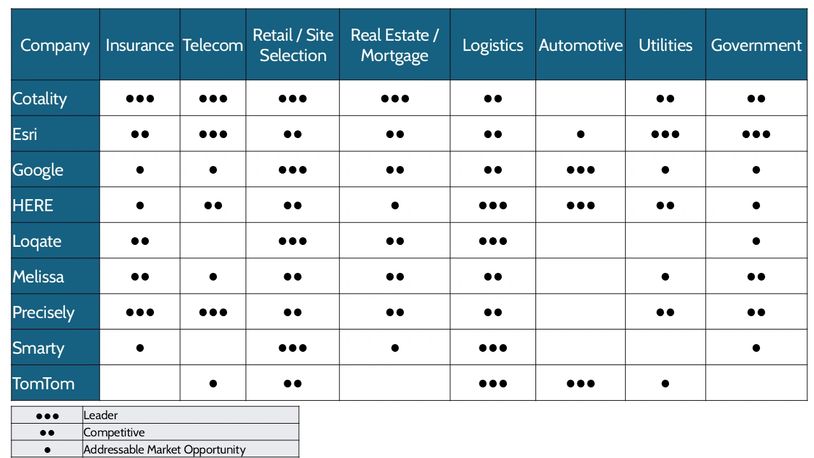
There is perhaps no better example of defending a competitive moat than the application of geocoding. TomTom, HERE Technologies, Precisely, Esri, Cotality and Google offer geocoding solutions where each are judged for accuracy and methodology. Street interpolated or “rooftop” geocoding differentiates each. The ability to determine postal and non-postal addresses (deliverable) addresses is important.
The use of a persistent identification number is critical in determining lineage of the address, especially as addresses change because of parcels becoming divided and thus requiring the issue of a new address. Accuracy determines whether an insurance company can properly underwrite an insurance policy, for example, as the proximity to perils (crime, traffic, flooding, wind) impacts pricing and therefore profitability. Mortgage companies, emergency management, and utility companies, just to name a few, rely on accurate geocoding.
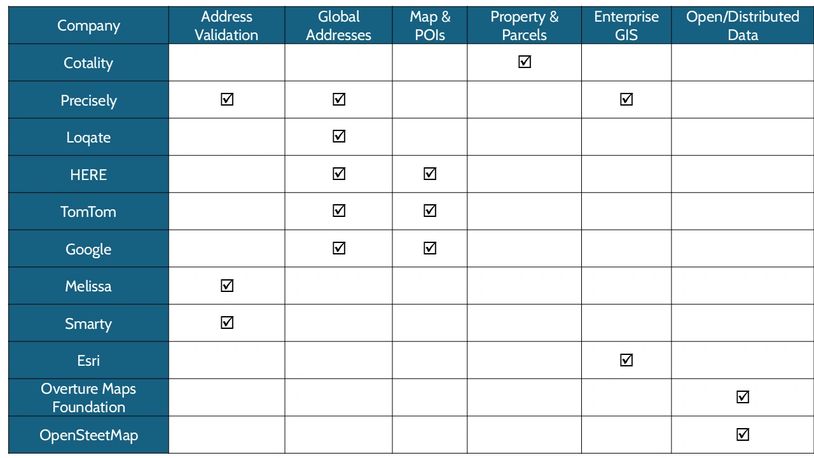
Below is a list of six strategic categories in which these companies compete
Precisely | Melissa | Smarty
Moat: accuracy, standardization, deliverability and data quality.
Loqate
Moat: international coverage, local addressing conventions and reference data.
HERE | TomTom | Google
Moat: addresses + roads + POIs + businesses + routing + continuous map updates.
Esri
Moat: geocoding embedded in a massive enterprise spatial platform and workflow ecosystem.
Cotality
Moat: address → parcel → structure → property → persistent property identity.
OpenStreetMap | Overture Maps Foundation
Moat: community/network effects, openness and broad geographic participation.

The is a table of each company's primary moat, assets and differentiation.
We use cookies to analyze website traffic and optimize your website experience. By accepting our use of cookies, your data will be aggregated with all other user data.
